Invasive Species

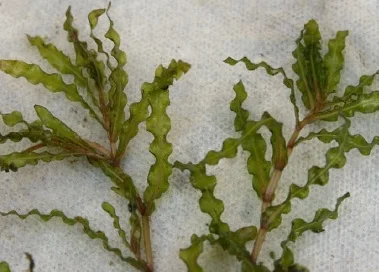
Curly-leaf pondweed

Eurasian watermilfoil.
Two invasive species are now firmly established in the LCO lakes, curly-leaf pondweed and Eurasian watermilfoil. Invasive aquatic plant species are nearly impossible to eradicate once introduced to lakes and streams. They were probably brought to LCO by boats from infested lakes, and their exuberant growth has been fueled by excessive phosphorus concentrations in LCO’s water. Unfortunately, both invasive species are easily distributed throughout the LCO lakes by plant fragments scattered by boat traffic. These invasives grow rapidly to form large mats that limit boat navigation and alter the fishery habitat. Late in the season, the invasive plants die back, settle to the lake bottom and decompose, which adds phosphorus and depresses dissolved oxygen concentrations, further harming the fishery. Of the two invasives, Eurasian watermilfoil is the real beast. It increased rapidly since it was first noticed 2015 and is now distributed throughout both LCO lakes. Despite COLA’s best efforts, its spread is accelerating.
(More on curly-leaf pondweed and Eurasian watermilfoil identification)
What COLA is doing about it
COLA is using all the tools and scientific methods at our disposal to preserve our lakes.

This starts with a constantly updated comprehensive Aquatic Plant Management Plan. Strategies include Controlling the introduction of new invasives, Mapping and Removing aquatic invasive plants, Applying safe, effective, well-targeted Herbicide Treatment, Mechanical Harvesting (the Eco-Harvester), DASH (diver assisted suction harvesting) and Hand Harvesting where best applicable. We also promote efforts to Eliminate Excessive Nutrients (such as phosphorus) in LCO’s water.

The fight against Aquatic Invasive Species in LCO and Little LCO: how we did in 2025.
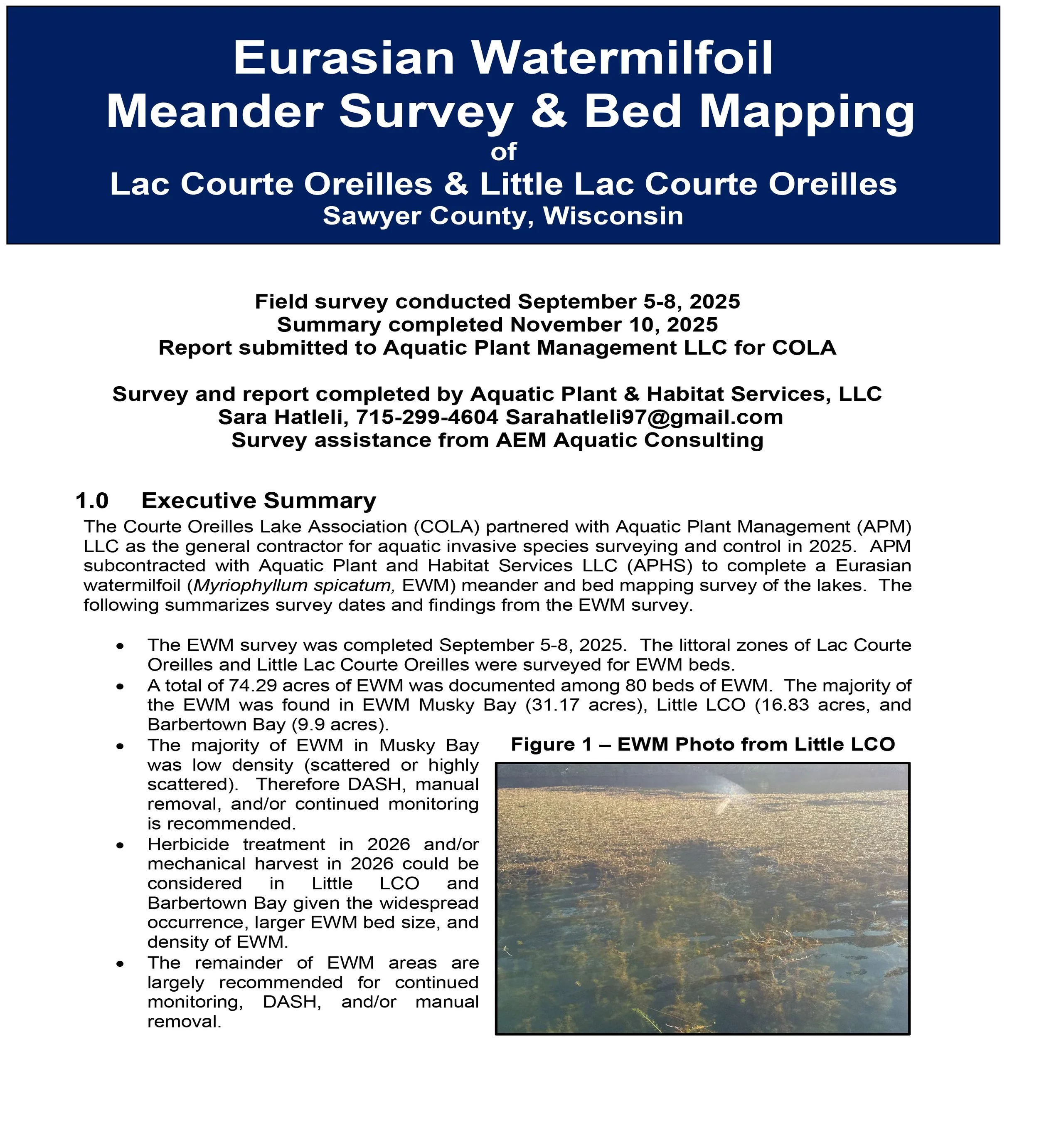
AIS, specifically Curly-leaf pondweed (CLP) and Eurasian Watermilfoil (EWM) are a real and ongoing threat to our lakes and need to be continuously controlled and eradicated where possible to preserve lake ecology. COLA partnered with Aquatic Plant Management to survey and map problem areas. The majority of EWM and CLP beds were found in Little LCO, Musky Bay and Barbertown Bay, with a focus on 12 areas within these. Treatment methods depended upon the nature, location, and density of the sites. COLA employed Herbicide treatment, Mechanical Harvesting (the Eco-Harvester), DASH (diver assisted suction harvesting) and Hand Harvesting where best applicable.
Little LCO, unfortunately, hasn’t be treated due to difficult access using Mechanical Treatments, and the DNR hasn’t permitted Chemical Treatment due to wild rice proximity further downstream in Billy Boy Flowage. We’re doing our best to solve this for 2026.
Altogether, COLA spent $108,633 on efforts to fight Aquatic Invasive Species in 2025. It’s a costly battle. And it’s easy to see why we need the support from everyone on our lakes. We are budgeting $157,914 for 2026.
Here are the results:
-Overall, 21/24 (~90%) sites that had active management met success criteria.
-The 15 EWM beds that were targeted with DASH or Hand Harvesting were reduced to 4EWM beds, eliminating 11 beds.
-Herbicide treatment (2,4-D) was successful in reducing 85% of targeted area and adensity reduction.
-6 of the 12 focus areas saw reductions of EWM acreage, with the other 6 seeing increasesin EWM acreage. Approximately 75% of the acreage increases came from Musky Bay andLittle LCO in areas where little to zero active management occurred.
-Mechanical harvesting delivered seasonal access, particularly in the Barbertown area.
A detailed summary of the EWM and CLP surveys, maps of problem areas on the lakes, and recommendations for 25-26 can be found HERE> and HERE>
We are currently finalizing the 2026 Management Plan and will be sharing that in the coming months.
2026 LCO Aquatic Plant Management Plan
COLA initiated its first LCO Aquatic Plant Management Plan in 2011 and updated it in 2021. The 2026 APM plan was presented at the Annual Meeting. As in our successful efforts in 2025, COLA is working with APM to map, prioritize, control and treat invasive species in LCO. Read the plan HERE >

Control Introduction of New Invasives
Three public boat landings on Lac Courte Oreilles assist the public in launching and retrieving their boats all summer long: Victory Heights (Town of Sand Lake) in the west basin; Anchor Bay (Town of Bass Lake) in the east basin; and the WDNR ramp in Chicago Bay in the central basin. The Victory Heights and Anchor Bay ramps serve the immediate neighborhoods and are primarily used by the local populations, while the WDNR Chicago Bay ramp is used by lake visitors—and that is why COLA monitors it for aquatic invasive species. COLA has long employed boat monitors to inspect boats coming to and leaving LCO at the DNR landing in Chicago Bay. In 2022, COLA installed the Internet Landing Installed Device Sensor (I-LIDS) at the Hwy K ramp. I-LIDS is a real-time video inspection system for boats. If successful, the system may be used at other landings.

Eliminate Excessive Nutrients in LCO’s Water
Phosphorus reduction is essential, especially from the discharges from the cranberry marshes on LCO’s shores. Property owners are encouraged to carefully monitor their septic systems, provide shoreland buffers, and limit impervious surfaces. COLA and the LCO Tribe have been working with the WDNR since 2016 to establish a lower phosphorus standard, termed a “Site Specific Criterion” (SSC), for the LCO lakes (excluding Musky Bay). The site-specific criterion (SSC) of 10 μg/L for phosphorus for Lac Courte Oreilles was finally approved by the Wisconsin State Legislature following the recommendation of WDNR’s Natural Resources Board and Governor Evers.
This is a tremendous victory for Lac Courte Oreilles.
A huge challenge remains. The new 10 μg/L phosphorus standard can only be reached by voluntary actions because all sources of phosphorus on LCO are currently regarded as “non-point” under the Clean Water Act. This means that there are no regulatory measures available under federal or state law to control phosphorus pollution.
More than 40% of the readily-controllable phosphorus is coming from the cranberry marshes on LCO. The discharges from the marshes can be cleaned up by recycling water by the use of holding ponds. COLA, the LCO Tribe, and the WDNR will renew efforts to bring the cranberry growers into an alliance dedicated to reducing phosphorus pollution.
More …

Lac Courte Oreilles Aquatic Invasive Species Lake Monitoring Training Manual
Available here.

REMOVING EURASIAN wATERMILFOIL AROUND DOCKS AND IN SHALLOW PARTS OF YOUR SHORELINE
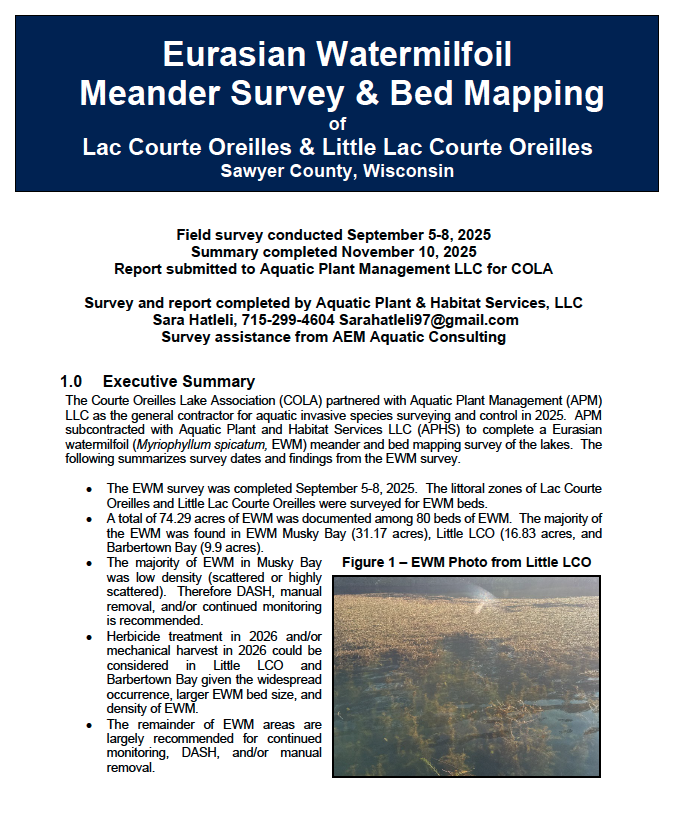
LCO & Little LCO 2025 Aquatic Plant Survey Report & maps
Aquatic invasive species (AIS) continue to be a problem, of particular concern are curly-leaf pondweed and Eurasian watermilfoil on both Lac Courte Oreilles and Little Lac Courte Oreilles. The report and maps are available here> and here>.
How can you help?
Please support COLA’s Clean Boat Initiative by routinely inspecting all of your watercraft for AIS. If you have the time, please join COLA’s AIS or Eco-Harvester work groups to help identify and remove AIS.
Learn more
"A Boaters Guide to Aquatic Invasive Species"
www.siyachts.com/boater-guide-to-aquatic-invasive-species
Related Stories in Short Ears, Long Tales
Issue 22 'Lac Courte Oreilles Boat Landings'
Issue 39 ‘A Short Lesson on the Ecology of Two Invasive Plants’
Issue 40 ‘Protecting the Lakes: Aquatic Invasive Species Mapping and Management’
Issue 47 ‘The Early Voyages of the Eco-Harvester’
Issue 48 ‘Invasive Mystery Snails’
Issue 50 ‘Milfoil(ed) Again’
Issue 52 ‘Tales of Two Plants’
Issue 57 ‘Aquatic Invasive Species - What Happened in 2022’